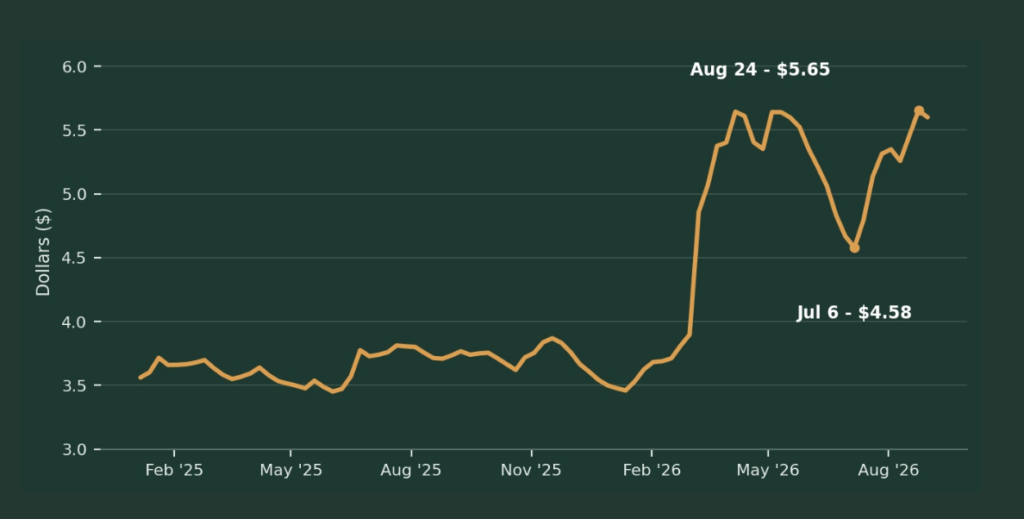
Diesel fell for six straight weeks this summer, the longest stretch of relief carriers saw all year. By late August it had erased the drop and set a new high for 2026. Carriers still running static surcharges priced loads against a number that was already stale by the time it delivered.
Diesel peaked at $5.64 the week of May 4, matching April's high. Then it turned. Six straight weeks of declines took the national average from $5.523 on May 25 down to $4.578 by July 6, the lowest reading since February. For carriers running static surcharge schedules, this looked like the market finally normalizing. Rate confirmations written that June priced fuel at a level nobody expected to hold past summer.

It didn't hold. The week of July 13 added $0.22 at the pump. By July 20 diesel was back above $5.13, a $0.34 jump in a single week. It kept climbing through August, hitting $5.652 on August 24, a new high for the year and above even the April peak. Every load tendered in June or early July against the summer number was already underpriced by the time it delivered.
Carriers who reset their surcharge assumptions to the June low absorbed the full gap when August arrived. A monthly or quarterly reset can't see a swing like this coming, and it can't correct for it after the fact either. The load is already delivered by the time the next reset catches up.
Two full reversals in eight months. Diesel isn't moving in one direction long enough for a static number to stay accurate. The carriers managing through it aren't the ones who guessed right on timing. They're the ones pricing every load against what fuel actually costs on the day it moves, not what it cost when the schedule was last updated.
Magnus interrogates any published index, ingests it on the cadence it publishes, and rewrites every load to that index automatically.
Every surcharge ties to the moment that matters: tender accept, pickup, or delivery. Every load is independently verifiable in real time, so carriers stop carrying costs the surcharge was supposed to absorb.